

The short answer: grade first, drain where grading can't do the job
Ground around the house should slope away from it. When the site is level or tilts toward the house, its next options depend on space. With room to work, it points to swales. With limited room, it points to French drains carrying water underground to a drywell, a lower spot, or off site.
- Yard slopes toward the house and there's open ground: regrading or a swale is the first thing to look at.
- Little room, or water sits in low spots: a French drain under turf, stone or mulch can reduce ponding.
- Heavy, fast runoff: a French drain at the base of a swale can move large volumes faster.
Why runoff is worth fixing
Runoff adds up quickly. Water left around a foundation can reach a basement or crawlspace. Saturated foundations and siding can lead to mold and poorer indoor air.
When regrading or a swale makes sense
Grading and swales work at the surface. They let water flow away and soak into the soil. A swale is a trapezoidal channel dug to take stormwater overflow, usually planted to limit erosion and filter runoff. It often runs along a property line or at the bottom of a slope, and can catch water that would sit in a flat yard or flow toward the house from uphill.
- Building America Solution Center specs: swale sides no steeper than 3 to 1 (width to height).
- The channel should fall a steady 2% to 4%. Under 2% tends to pool, and over 4% speeds water up and causes erosion.
When a French drain makes sense
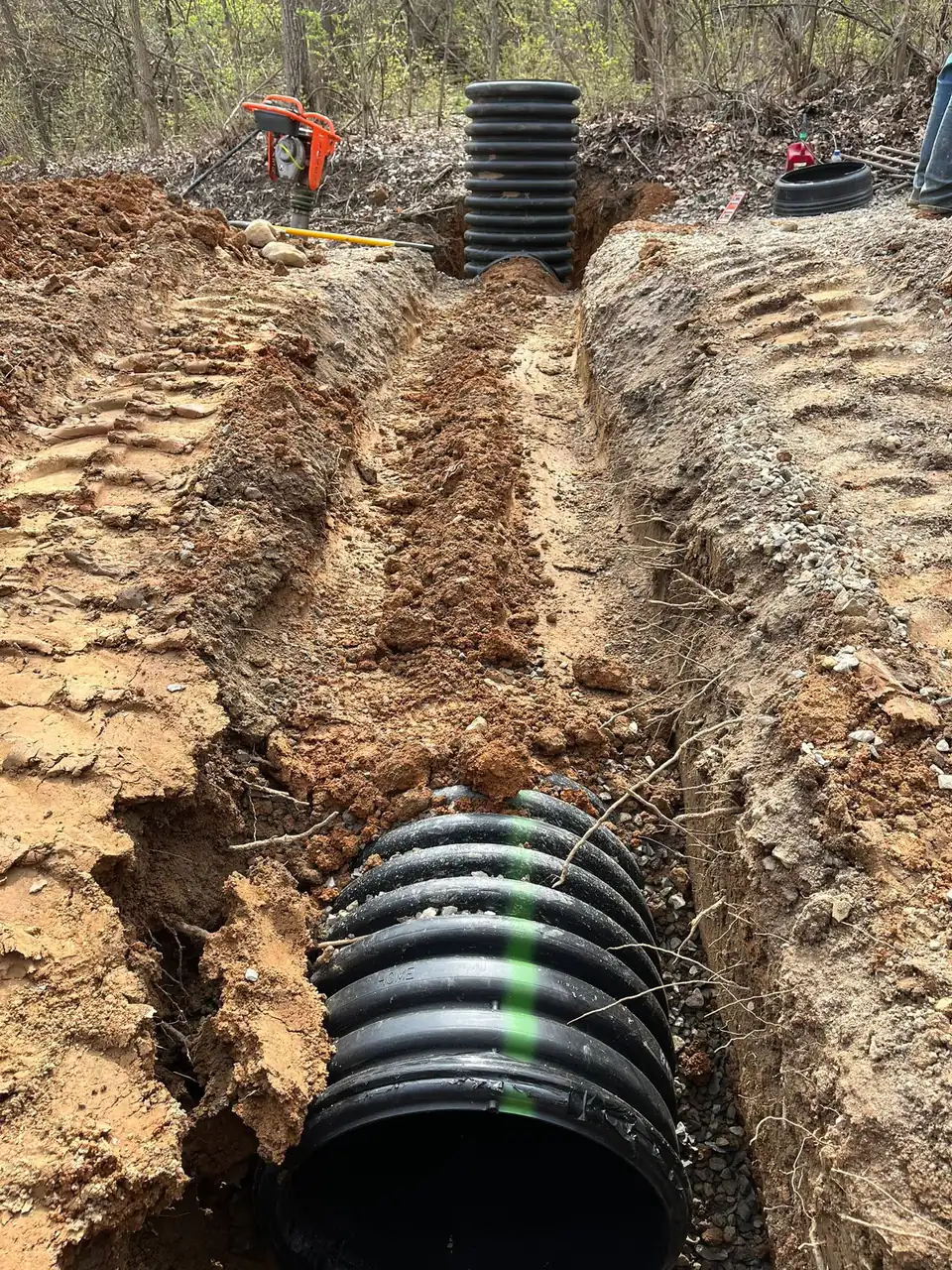
A French drain is a perforated pipe wrapped in rock and landscape fabric and buried at a low point. It collects water below the surface. The pipe then carries it to a lower part of the site, a drywell, or a storm system. The Building America Solution Center points to drains where the site is level or slopes toward the house and space is limited.
- Building America Solution Center guidance: set the drain 18 inches or more below ground, sloping steadily toward its outlet.
- Its install steps call for a trench at least 22 inches deep and 14 inches wide.
- The same guidance notes corrugated pipe is more likely to collect sediment and clog.
- If the drain empties at the surface, the outlet should land on ground sloping away from the house, with stones or a splash block to limit erosion.
- Keep shrubs and trees off and away from the pipe.
- Many communities require stormwater to be handled on site, so where the water ends up matters.
Questions to ask before you hire
Either fix depends on how your yard slopes, how much room you have, and where the water can go. Use these questions to compare options.
- Which way does my yard slope now, and can it be regraded away from the house?
- Is there room for a swale, or does space call for an underground drain?
- Where will the collected water discharge: a lower part of the site, a drywell, or off site?
- What pipe, fabric and depth are planned for a drain?
What getting an estimate from B&K has looked like
The following comes from B&K's Google reviews, not B&K's own promises. Kurt wanted to see the area before the stumps were ground and explained that sometimes it's best to remove them entirely.
Common questions
Should I regrade the yard or install a French drain?
Start with grading. According to the Building America Solution Center, ground should slope away from the house. If your lot is level or tilts toward the house and you have room, a swale can carry and soak up runoff. If space is limited or water pools in low spots, a buried French drain can collect it and pipe it to a lower spot, a drywell, or off site.
Next step
Request a quote